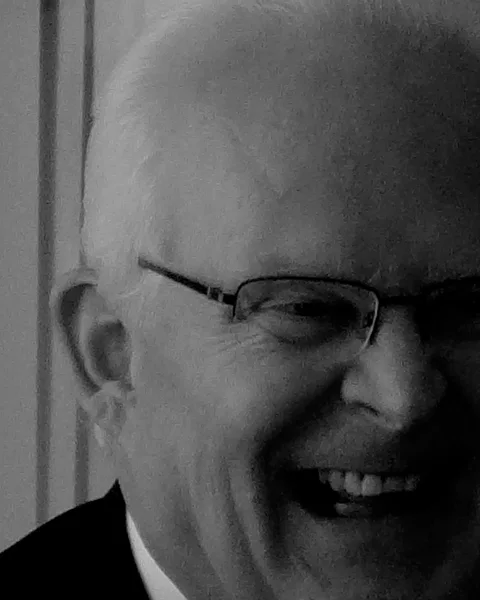
Business designer and inventor
Chauncey Bell
Fernando Flores’s long-time collaborator and his right hand in building the Coordinator. He worked patiently with our founders for years, and eventually brought us to Fernando himself.
Chauncey Bell is a business designer and an inventor. He works with senior executives and with the consultants who serve them, across North America, Latin America and Europe, on the skills, the processes and the culture of an enterprise. His own site reports that the work has produced hundreds of millions of dollars of growth and savings for clients each year, and that the consultants he has trained and mentored have produced hundreds of millions more over the past twenty years.
What he actually does is hard to name in the usual vocabulary, which is part of why the usual vocabulary keeps missing the thing he works on. He looks at an enterprise and sees the conversations: who is asking whom for what, which promises were made and which were only assumed, where the loop never closed and everybody went on as though it had. Then he shows people that what they had been calling personality, or politics, or just the way things are around here, is a structure, and that structures can be redesigned.
The idea COROS leans on hardest is his: coordination waste. Waste, in his definition, is an assessment that resources and capacities are being spent in ways that do not advance what we are concerned with. His claim, which he spent decades testing inside real companies, is that the waste in how people coordinate is routinely larger than the waste in the work itself, and that it sits on no accounting report, because our accounting systems have eyes only for things with a purchase price.
He holds about six software patents. His degree is an AB in English Literature from Harvard. Both of those facts are worth holding at once, because his work sits exactly where they meet: a formal, mappable account of human commitment, written by someone who reads.
“A formidably important feature of holding on to big questions is avoiding the temptation to put more attention on answers.”
What the work has produced
Reported on his own site, and worth reading as a specimen of the method.
-
A semiconductor fab
Helped a program manager install tools on time and at roughly forty percent below projected cost, with scope changing underneath them and more than 2,200 craftspeople on the job.
-
A utility
Dozens of projects completed inside a year, delivering over nineteen percent more power than had been promised to the regulator, at over fifteen percent less cost than allowed.
-
Wind farms
Laid out practices that cut cycle times by about a quarter across ten billion pounds of new wind capacity.
-
An online bank
Helped shape a new retail bank that opened in ten months with regulator approval, and reached roughly fifteen percent market share inside twenty-four months.
- Education
- AB in English Literature, Harvard University
- Patents
- Approximately six, in software
- Book
- Mobilize!: Dancing in the World
- Clients
- IT, hardware and software, semiconductor, banking, heavy equipment, telecom, power, process industries, governments, and startups
What we took from him
From Chauncey we learned to hear the word conversation for what it is: con, together; verse, to turn; tion, the ongoing process. To converse is to turn together, to change, with another. That is the whole of it, and it is the centre of everything we build. The four acts of work that run underneath COROS, the request, the promise, the report of completion and the declaration of satisfaction, are the loop he and Fernando Flores described, and they are the oldest idea in the product.
Read him yourself