Voice Comes to COROS
COROS AI Model 3.1 | March 2026
There is something that happens when you speak out loud about what is bothering you. Something that typing cannot replicate.
When you type, you edit. You clean it up. You make it sound reasonable. You soften the edges. By the time you hit send, the raw truth has been polished into something manageable, and manageable is precisely what keeps you stuck.
When you speak, the mess comes out. The hesitation. The contradiction. The thing you did not plan to say but said anyway because your voice moved faster than your inner censor. That is where the real material lives. That is where coaching begins.
Starting today, COROS speaks and listens.
A Different Medium, A Different Conversation
This is not a minor feature update. Speaking and listening is an entirely different medium than reading and writing. It changes what you bring and how you receive it.
Think about the last time someone asked you a hard question face to face versus over text. The text version gave you time to construct a careful response. The spoken version caught you off guard, and in that unguarded moment, something true emerged.
We built voice into COROS because coaching has always been a spoken art. The ontological tradition that COROS is built on, the work of Fernando Flores, the practice of listening to moods, making assessments, navigating breakdowns, all of it was born in live conversation. In the back and forth between two people, where tone carries as much meaning as words.
Now COROS meets you there.
How It Works
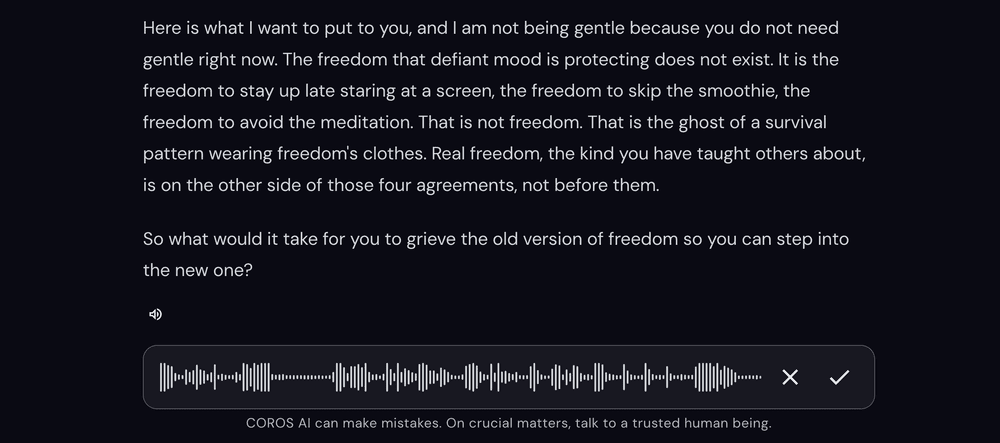
Speaking to COROS: You will find a microphone icon in the text input area. Tap it, and speak. Say what is on your mind in your natural voice, no need to organize your thoughts first. In fact, the less organized, the better. Once your speech is transcribed, you can review it, edit if you want, and send it to COROS.
Listening to COROS: When COROS responds, you will see a small speaker icon underneath each message. Press it, and COROS reads its response to you in voice. You can listen while you drive. While you walk. While you sit with your eyes closed and let the words land differently than they would on a screen.
Going back: Here is something we are especially excited about: you can go back to any previous COROS response in your conversation history and listen to it. Revisit a perturbation that moved you. Replay a diagnosis that named what you could not name yourself. Sometimes the same words hit differently the second time, especially when you hear them spoken.
FIGURE 1 - Voice Features Launched in COROS Model 3.1
Meet Cora
The current voice of COROS is called Cora. She is our first voice, a beta, our version 1. We are not going to pretend she is perfect. She can sound mechanical at times. But she gets the job done, and many of our users have already told us they prefer listening to COROS over reading it.
Behind the scenes, we are working on something we believe will be a breakthrough: a voice called Leah. We are not ready to share her yet, but when she arrives, you will hear the difference. Leah is being built to carry the weight that coaching conversations demand: warmth, directness, and the kind of presence that makes you feel heard even through a speaker.
For now, Cora is here. Give her a chance.
Why This Matters
We did not build voice because it is trendy. We built it because our users told us, and we observed, that the biggest barrier to a deep coaching conversation was the act of typing itself.
You are in your car after a brutal meeting, replaying the conversation in your head, feeling the weight of something unresolved. You want to process it. You want to talk to someone. But typing a paragraph on your phone while driving is not an option, and by the time you get home, the moment has passed. The mood has shifted from hot urgency to dull resignation.
Now you tap the microphone and speak. Raw. Unedited. While the experience is still alive in your body.
That changes everything.
And on the other side, when COROS responds with a sharp assessment of the mood you are sitting in, or names the assessment that has been running your life without your permission, reading it is one thing. Hearing it spoken to you is another. The voice adds a dimension that text alone cannot deliver. It lands in a different place.
Use It On The Go
COROS with voice is built for the pace of your life. You do not need to be at a desk. You do not need to set aside thirty minutes. You can have a coaching conversation:
In the car on your commute. On a walk to clear your head. In bed at the end of a long day when typing feels like too much work. In a quiet moment between meetings when something is weighing on you.
You do not have to type lengthy messages. Speak them. You do not have to read lengthy responses. Listen to them. This is COROS, meeting you where you are.
Try It. Tell Us What You Think.
We are releasing this as a live feature, not a polished product launch. We want you to use it, break it, love parts of it, be frustrated by other parts, and tell us everything.
What do you like about Cora's voice? What drives you crazy? Is the speech-to-text accurate enough? Do you find yourself going deeper when you speak versus type? Does listening to COROS change how the coaching lands?
We want to hear all of it.
Send your thoughts to [email protected]. We read every message.
This is how COROS gets built, not in a lab, but in partnership with the people who use it to navigate the hardest conversations and moods of their lives. Your experience shapes what comes next. Your voice, literally now, shapes ours.
Speak. Listen. Let us know.
The COROS AI Team