Anthropic's Data Says Your Job Is Next. Build What AI Can't.
Last week, Anthropic, the company behind Claude, one of the most powerful AI systems on the planet, published a research report that should have stopped every working professional in their tracks. It's called "Labor Market Impacts of AI: A New Measure and Early Evidence," written by Maxim Massenkoff and Peter McCrory. And it does something no AI company has done before with this level of rigor: it uses its own usage data to measure, in real time, which jobs are being consumed by artificial intelligence.
Not theoretically. Not in a forecast. In actual observed behavior, drawn from millions of conversations on their platform.
I read it three times. And what struck me wasn't just the data, which is stark. It's what the data reveals about a question no one at Anthropic is asking, because it's not their question to ask.
It's ours.
Let me walk you through what they found. Then I want to tell you what I think it means. Not for the economy in the abstract, but for you. For your career, your craft, your capacity to matter in a world that is reorganizing itself around machines that speak our language.
What Anthropic Actually Measured
Most studies on AI and jobs rely on theory. They ask: Could an AI do this task? Anthropic did something different. They combined three data sources: the O*NET database of roughly 800 U.S. occupations, task-level exposure estimates from Eloundou et al. (2023) measuring whether an LLM could theoretically double a task's speed, and, here's the kicker, their own real-world usage data from the Anthropic Economic Index, which tracks what people are actually using Claude to do.
They called their new metric observed exposure. It's not about what AI could do. It's about what AI is doing, right now, in professional settings. And it weights automated uses, the kind where no human is in the loop, more heavily than augmentative ones, where a person is still directing the work.
This distinction matters enormously, and I'll come back to it.
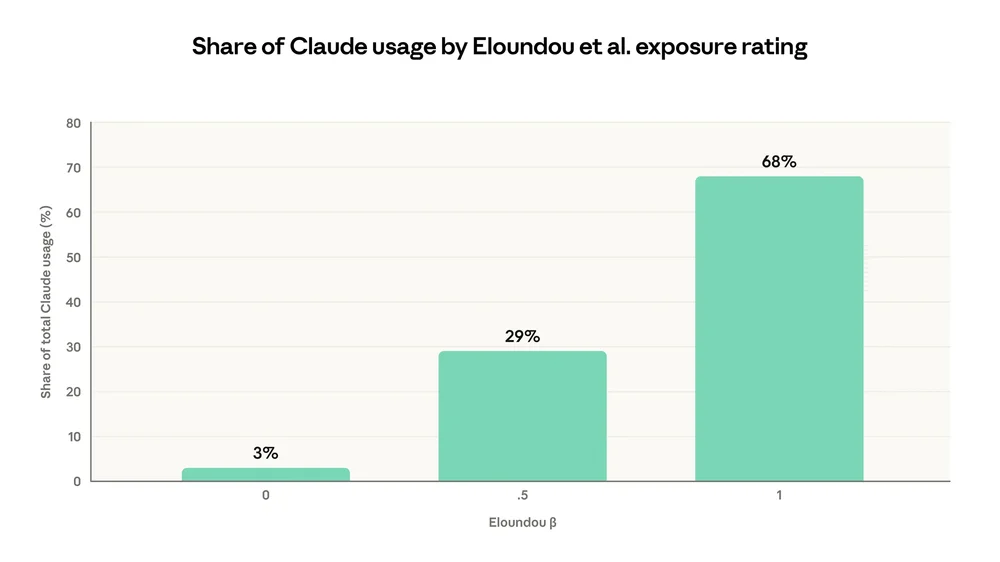
Figure 1: Share of Claude usage by Eloundou et al. task exposure rating
This figure shows Claude usage distributed across O*NET tasks grouped by their theoretical AI exposure. Tasks rated β=1 (fully feasible for an LLM alone) account for 68% of observed Claude usage, while tasks rated β=0 (not feasible) account for just 3%. Data on Claude usage comes from the previous four Economic Index reports.
The Numbers That Should Wake You Up
Here is what the data shows.
Computer programmers sit at the top of the exposure list, with 75% of their tasks now covered by observed AI usage on Anthropic's platform. Customer service representatives follow closely, driven largely by first-party API traffic, meaning companies are building automated systems on top of Claude to handle customer interactions without human involvement. Data entry keyers are at 67% coverage. Financial analysts, technical writers, and web developers all rank in the top ten.
On the other end, 30% of the entire American workforce has zero observed exposure. These are the cooks, the motorcycle mechanics, the lifeguards, the bartenders, the dressing room attendants. The people whose work is physical, embodied, relational in ways that cannot be digitized.
And here's a number that stopped me cold: 97% of all tasks that people are actually using Claude for fall into categories that researchers had already rated as theoretically feasible for AI. In other words, the theory predicted the practice almost perfectly. What the theory overestimated was the speed of adoption, not the direction.
The gap between what AI could theoretically do and what it is actually doing is enormous. In Computer and Math occupations, the theoretical capability covers 94% of tasks. The actual observed coverage? Just 33%. That gap is closing. And as Anthropic themselves note, the red area of actual usage will grow to cover the blue area of theoretical capability as models improve, adoption spreads, and deployment deepens.
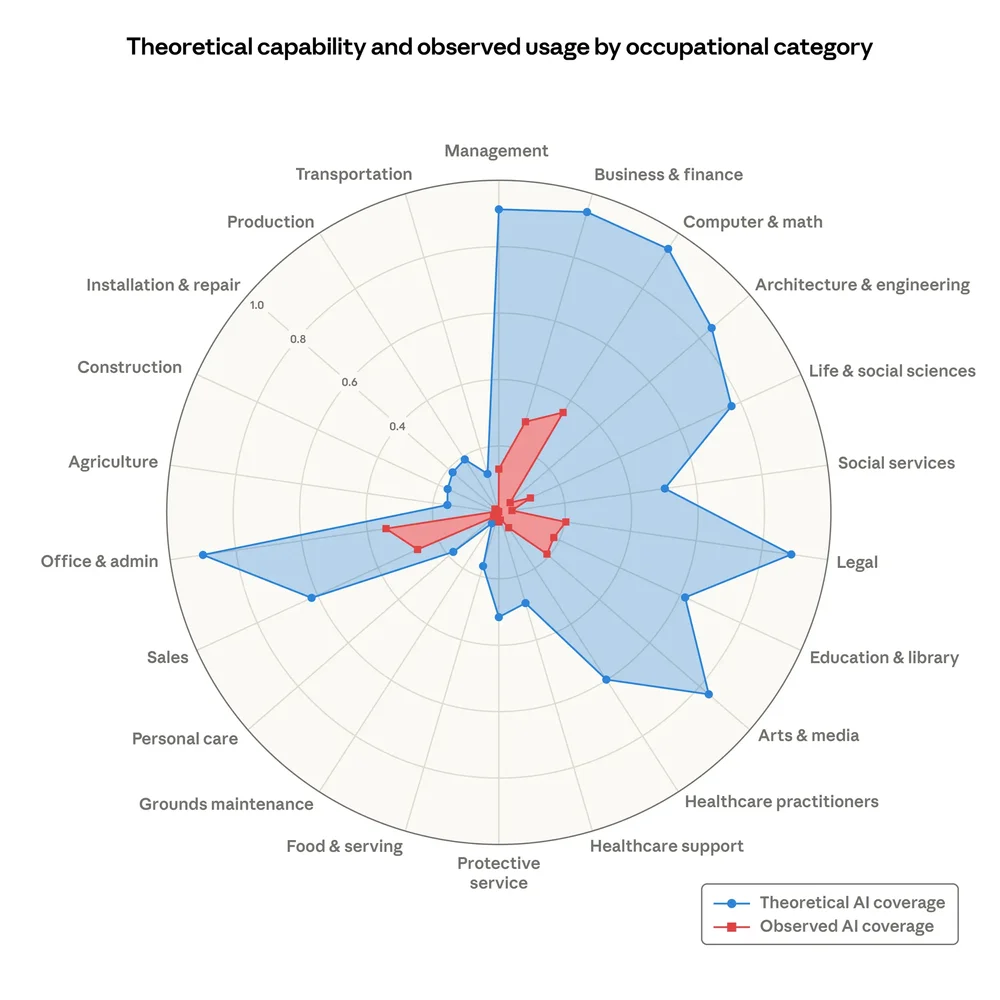
Figure 2: Theoretical capability and observed exposure by occupational category
Share of job tasks that LLMs could theoretically perform (blue area) and our own job coverage measure derived from usage data (red area).
Who Gets Hit
The demographic portrait of the most exposed workers is uncomfortable. Compared to workers with zero AI exposure, those in the top quartile are 16 percentage points more likely to be female. They are 11 percentage points more likely to be white. They are almost twice as likely to be Asian. They earn 47% more. And they are dramatically more educated. People with graduate degrees make up 17.4% of the most exposed group, compared to just 4.5% of the unexposed group. That's a nearly fourfold difference.
This is not the story we've been told. The narrative of AI disruption has been written as a blue-collar threat. Robots on the factory floor, autonomous trucks on the highway. Anthropic's data says something else entirely. The people most exposed to AI displacement right now are educated, well-paid, white-collar professionals. The knowledge workers. The people who spent decades learning to think in systems, to process information, to translate complexity into documents and code and analysis.
In short: the people who got the best at becoming like computers are the ones most at risk of being replaced by them.
The Employment Signal, and Its Silence
Now here's where the report gets both reassuring and deeply unsettling at the same time.
Anthropic found no systematic increase in unemployment for workers in the most AI-exposed occupations since ChatGPT launched in late 2022. The unemployment rate for the most exposed workers has remained roughly flat, tracking alongside less-exposed workers. The authors are careful and precise about this: the effect is indistinguishable from zero.
But there's a crack in the data. Among young workers, ages 22 to 25, Anthropic found a 14% drop in the rate at which they're being hired into exposed occupations. Not a spike in layoffs. A quiet contraction in hiring. The door isn't slamming shut. It's slowly narrowing. And for workers over 25, there's no such effect.
This echoes findings from Brynjolfsson et al., who reported a 6 to 16% fall in employment in exposed occupations among young workers, attributing it primarily to slowed hiring rather than increased separations.
Think about what this means. If you're 45 and you're a financial analyst, you're probably fine, for now. Your institutional knowledge, your relationships, your organizational weight protects you. But the 23-year-old who was going to become the next you? That path is contracting. The entry-level rung of the ladder is being pulled up. Not violently, not overnight, but steadily, measurably, and in the exact occupations where AI coverage is highest.
The Bureau of Labor Statistics seems to sense this too. Anthropic found that for every 10 percentage point increase in their observed exposure measure, the BLS's employment growth projection from 2024 to 2034 drops by 0.6 percentage points. The jobs AI is consuming are the same jobs the government expects to grow the least over the coming decade.
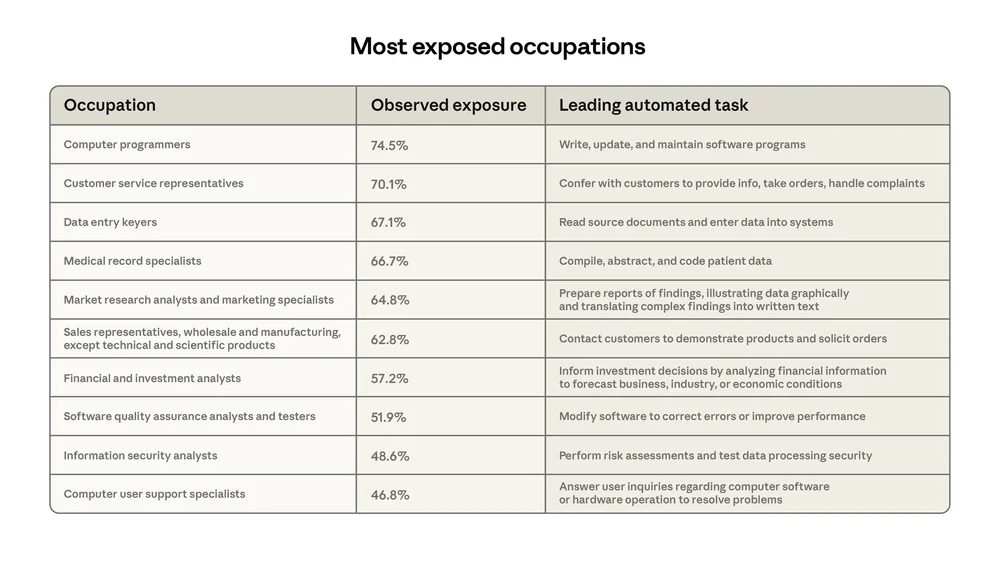
Figure 3: Most exposed occupationsTop ten most exposed occupations using our task coverage measure.
What the Report Doesn't Say
Anthropic's paper is excellent. It is careful, honest, methodologically rigorous. It openly acknowledges what it doesn't know. It hedges appropriately. It invites future analysis.
But it is, by design, a paper about measurement. It measures exposure. It measures employment trends. It measures demographic characteristics. What it does not do, what it cannot do, because it is not in the business of doing this, is answer the question that every person reading those charts should be asking:
What do I do now?
Not "what does the economy do?" Not "what should policy be?" But: what do I, as a human being who has spent my career building skills that are now being covered by machines at an accelerating rate... what do I do with that information?
This is where I want to shift the conversation. Because I've been thinking about this question for a long time. And the answer I've arrived at, through years of coaching, through thousands of hours of conversation, through a philosophical tradition that stretches back through Fernando Flores and Hubert Dreyfus to the deepest questions about what it means to be human, is not what most people expect.
The Real Disruption
For over a century, we have been computerizing human beings. We taught ourselves to think in computer logic, speak in computer metaphors, and work in computer rhythms. We talk about "bandwidth" when we mean capacity. "Processing" when we mean thinking. "Connection" when we mean relationship. We spent generations translating ourselves into a language machines could understand.
Now the script is flipping. We are not computerizing humans anymore. We are humanizing computers. The machines are learning to speak our language. They are adapting to us.
And this changes everything.
Look at Anthropic's data again through this lens. The occupations with 75% coverage, programmers, data entry, customer service, what do they have in common? They are roles that were already mechanized in spirit. Roles where the human being had been trained to function like a component in a system. To follow procedures. To process inputs. To generate predictable outputs.
The 30% of the workforce with zero exposure? Cooks. Mechanics. Bartenders. People whose work requires embodiment, improvisation, relational attunement. The capacities that resist digitization because they are irreducibly human.
The lesson is not that some jobs are safe and others are doomed. The lesson is that the human capacities embedded in certain kinds of work are what resist automation. And those capacities can be cultivated in any role, in any profession, at any level.
What are those capacities?
They are the ones philosophers Dreyfus, Flores, and Spinosa called "skills for making history." The ability to shape new worlds, forge new possibilities, create contexts that didn't exist before. These things happen in conversations between human beings that change the trajectory of organizations, families, and communities. AI will never do this. And we don't want it to.
We are narrative-dwelling beings. AI is a tool that serves that dwelling.
The Opportunity Hidden in the Data
Here's what I see when I look at Anthropic's report: a massive, unprecedented opportunity to reclaim what we lost during a century of self-mechanization.
The gap between theoretical AI capability and actual observed usage, that yawning space between the blue and the red in Anthropic's charts, is not just a measure of slow adoption. It is a map of where human judgment, human context, human sophistication still matters. It is a map of where the irreducibly human capacities live.
And the fact that young workers are the first to feel the contraction? That tells us something urgent. It tells us that the skills we've been training young people to acquire, the procedural, the analytical, the information-processing skills, are precisely the ones being absorbed by AI. We have been preparing an entire generation for jobs that are disappearing, while neglecting the capacities that would make them indispensable.
The ability to listen. Not to extract data from speech, but to hear what someone is really saying, what mood they are speaking from, what world they are trying to build or protect.
The ability to speak with power. Not to deliver presentations, but to make commitments that open new futures, to create contexts that didn't exist a moment before.
The ability to manage breakdowns. Not as problems to be solved, but as revelations about what matters, what's missing, what's been avoided.
The ability to coordinate. Not to manage tasks, but to build trust, repair relationships, and forge alliances that make new action possible.
These are not soft skills. That phrase is an insult to the most important capacities a human being can develop. These are the skills. The hard ones. The ones that take years to cultivate and cannot be automated because they require a body, a nervous system, a history of care and commitment and failure and recovery.
This Is the Work
This is exactly the work we have placed at the center of everything we do at COROS AI and Conceivian. Not because we predicted Anthropic's report, but because we've been watching this pattern unfold for years, in the lives of the leaders, entrepreneurs, and professionals we coach.
We have accumulated over 10,000 hours of coaching conversations. What we've learned is that AI, used in a very particular way, not as a replacement for human thinking but as a linguistic mirror that helps you see your own patterns, your own avoidances, your own stuck moods, can accelerate the development of precisely the capacities that make you irreplaceable.
Not because AI can do what a master coach does. It can't. But because AI sits outside the social contract. It can ask you the question your spouse won't ask, your boss can't ask, your friend is afraid to ask. It can provoke you in ways that human relationships, bound by obligation, history, and politeness, simply cannot.
This is not the AI that Anthropic is measuring when they track task coverage and automation rates. This is a different use of AI altogether. Not AI that replaces human capacity, but AI that builds it.
Anthropic has given us the clearest picture yet of the disruption. The question now is not whether it's coming. Their own data shows it arriving, occupation by occupation, task by task, with young workers at the front of the line.
The question is whether you'll use this moment to become more like a machine, learning the next tool, the next prompt technique, the next way to compete with software on software's own terms.
Or whether you'll use it to become more fully human.
To recover the skills you lost. To cultivate the capacities that no machine can touch. To become indispensable. Not because you can do what AI does, but because you can do what AI cannot.
The revolution isn't coming. It's here. Anthropic just showed you the map.
The only question left: Are you ready to be indispensable in it?
Saqib Rasool is the Founder & CEO of COROS AI and Conceivian. He can be reached at [email protected].
The Anthropic report referenced in this article is available at: https://www.anthropic.com/research/labor-market-impacts